| Decision point | Documented figure or condition | Planning use |
|---|---|---|
| Dust protection | IP67: the first digit, 6, means completely dust-tight | Choose this for sand, grit and garden use. |
| Water protection | IPX4 is splash-proof only; IPX7 allows up to 1 m submersion for 30 minutes | Treat IPX4 as rain and spills only. Pick IPX7 or an IP67 model for pool edges and accidental drops. |
| Battery life | Stated hours are often measured at 50% volume with no light effects; Soundcore Select 4 Go lists 20 hours; Sony quotes up to 24 hours (ULT Field 3) and up to 25 hours (ULT Field 5) | Read the hours as a best case. Plan for less at party volume or with lights on. |
| Output power | Advertised wattage often refers to brief peak power | Never rank speakers on a headline watt figure alone. |
| Bass design | A passive radiator gives deeper bass than a compact body would normally allow | Look for one in small speakers that need low-end weight. |
| Pairing | True Wireless Stereo links two identical speakers; Sony Party Connect syncs up to 100 compatible speakers | Buy a matching pair for stereo, or stay inside one brand’s party ecosystem. |
Figures in this table come from a powerful-bass speaker guide and a Bluetooth speaker buying guide.
The best Bluetooth speakers for most buyers combine an IP67 rating, a battery claim that reflects realistic volume, and an honest power figure. Match size to how and where the speaker will be used.
For the wider picture on how to choose headphones, earbuds and speakers, the how to choose headphones guide covers the other portable audio options. This page narrows the choice to speakers.
Before you shop: decide the job first
A good Bluetooth speaker is one whose rating, battery and bass design suit where it will be used. Three features separate good speakers from weak ones: how well the body resists dust and water, how long the battery lasts at realistic volume, and how the speaker produces bass. The order of the steps below keeps the decision simple.
- Name the main location. Pool edges, beaches and gardens call for a stronger IP rating than a bookshelf or desk.
- Set the volume expectation. Personal listening at normal volume and a backyard gathering are different jobs, and they favour different sizes.
- Decide on one speaker or a pair. Stereo pairing needs two identical models, so the choice has to be made before buying, not after.
- Compare the same three figures across listings. These are the IP rating, the stated battery hours and the output power, and the sections below show how to read each one.
If the speaker will mostly sit under a TV instead of travelling, the best soundbar is usually a better fit than any portable model.
Reading the listing: IP rating, battery and power
What IP rating should a portable speaker have?
IP67 is the safest target for a portable speaker used outdoors. The first digit, 6, means the speaker is completely dust-tight, according to the powerful-bass guide. A buying guide describes the Anker Soundcore Select 4 Go as fully dustproof and waterproof, and able to float, which is the practical meaning of an IP67 rating on a small speaker.
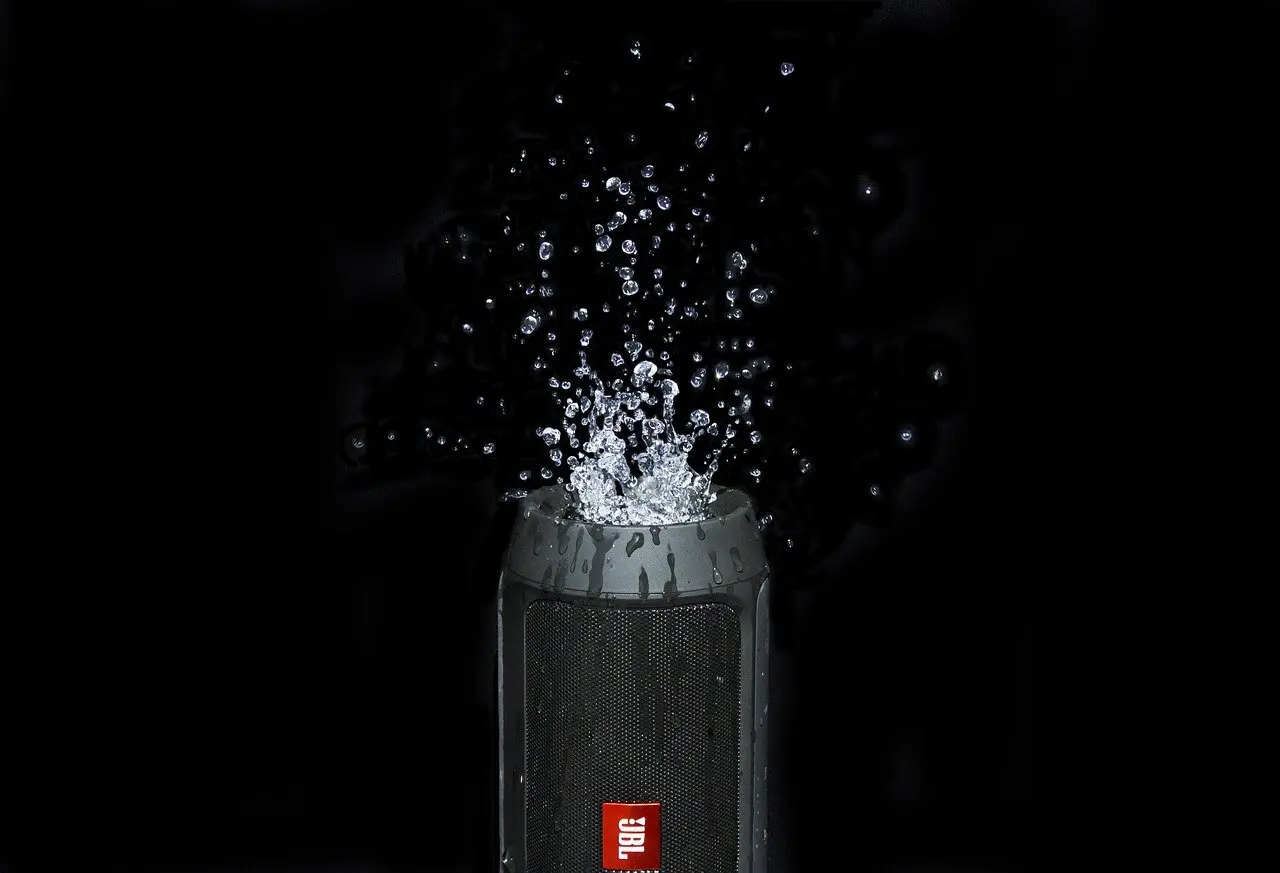
Water ratings need more care than dust ratings. The same guide notes that IPX4 only means splash-proof, so it suits rain and spilled drinks but not a drop into water. IPX7 is the submersible grade, allowing up to 1 m of water for 30 minutes. Choose IPX7 or an IP67 speaker if it will sit near a pool or travel in a bag on wet days.
Manufacturer battery figures
Stated battery life is a best-case figure. A buying guide points out that a “20-hour” claim is almost always measured at 50% volume with no light effects. The powerful-bass guide says the same about idealised test conditions. For the Soundcore Select 4 Go, the 20-hour figure is described as realistic for personal use at normal volume.
Long-battery speakers in the guides come from Sony. The ULT Field 3 offers up to 24 hours of playtime, and the ULT Field 5 is stated by Sony to reach up to 25 hours. Both are maximums, so a speaker played loudly with lighting on should be expected to run for fewer hours.
Choosing by size, price and loudness
Small speakers
The best small Bluetooth speaker is the one that keeps an IP67 rating and a realistic battery claim in a compact body. The Soundcore Select 4 Go is the clearest example in the supplied guides, pairing IP67 with 20 hours at normal volume. It suits a bag, a bike trip or a desk, and is the pick for personal listening rather than filling a yard.
Bass is the usual compromise in small speakers, and a passive radiator is the design to look for. According to the guides, it enhances low frequencies without consuming extra power. It also lets a compact speaker produce deeper bass than its size would normally permit.
Budget choices
For a tight budget, spend on the ratings before the extras. A listing’s price should be compared with the same three documented figures: IP rating, battery hours at stated volume and output power. Light effects reduce stated battery life, so they are a poor use of money on a low-cost model. Whether any specific speaker fits a given ceiling depends on its current listing price, so check that alongside the specification.
Loud speakers
Loudness cannot be read from a single wattage number. The powerful-bass guide warns that a very high advertised wattage often refers to brief peak power. Treat that number as a ceiling and look for rated output on the manufacturer’s spec sheet where one is given.
For a backyard gathering, favour a larger speaker with a long stated battery life, such as the Sony ULT Field range. Remember that the stated hours were measured at moderate volume. A shared-sound setup is another route to loudness: Sony Party Connect syncs up to 100 compatible speakers, so several mid-size units can replace one oversized speaker.
After unboxing: pairing and day-to-day use
Stereo pairing is the simplest upgrade for room-filling sound. Many modern speakers support True Wireless Stereo, which connects two identical speakers wirelessly so that one acts as left and the other as right. Since the speakers must match, the better time to commit to a pair is at purchase.
- Charge fully before the first outing. This gives a clear baseline for how long the speaker actually lasts.
- Play at your usual volume. Compare the real runtime against the stated hours, which assume moderate volume and no lighting.
- Set up stereo or party mode only with matching or compatible speakers. Mixed models usually will not link.
Troubleshooting common problems
- Battery runs out sooner than advertised. Loud playback and light effects both fall outside the conditions used for the stated hours. Lower the volume or switch the lights off.
- Two speakers will not link in stereo. True Wireless Stereo expects two identical speakers. Different models need a shared multi-speaker feature, such as Party Connect, and both must be compatible.
- Speaker was rated only for splashes. An IPX4 model should not be submerged. Only IPX7 is documented for submersion, and only for the stated depth and time.
- Bass sounds thin on a small speaker. Check for a passive radiator in the specifications. A speaker without one has fewer ways to produce deep bass in a compact body.
Frequently asked questions
Does a larger mAh figure mean longer playtime?
Usually. A buying guide says a battery of 5000 mAh or more typically means longer actual playtime, though the stated hours still depend on volume and lighting.
How should I store a speaker I will not use for a while?
Keep the battery at about 50% charge, as the Bluetooth speaker buying guide advises, rather than fully empty or full.
Can more than two speakers play together?
Yes, on compatible models. Sony Party Connect can synchronise up to 100 compatible speakers, while stereo pairing is limited to two identical speakers.